
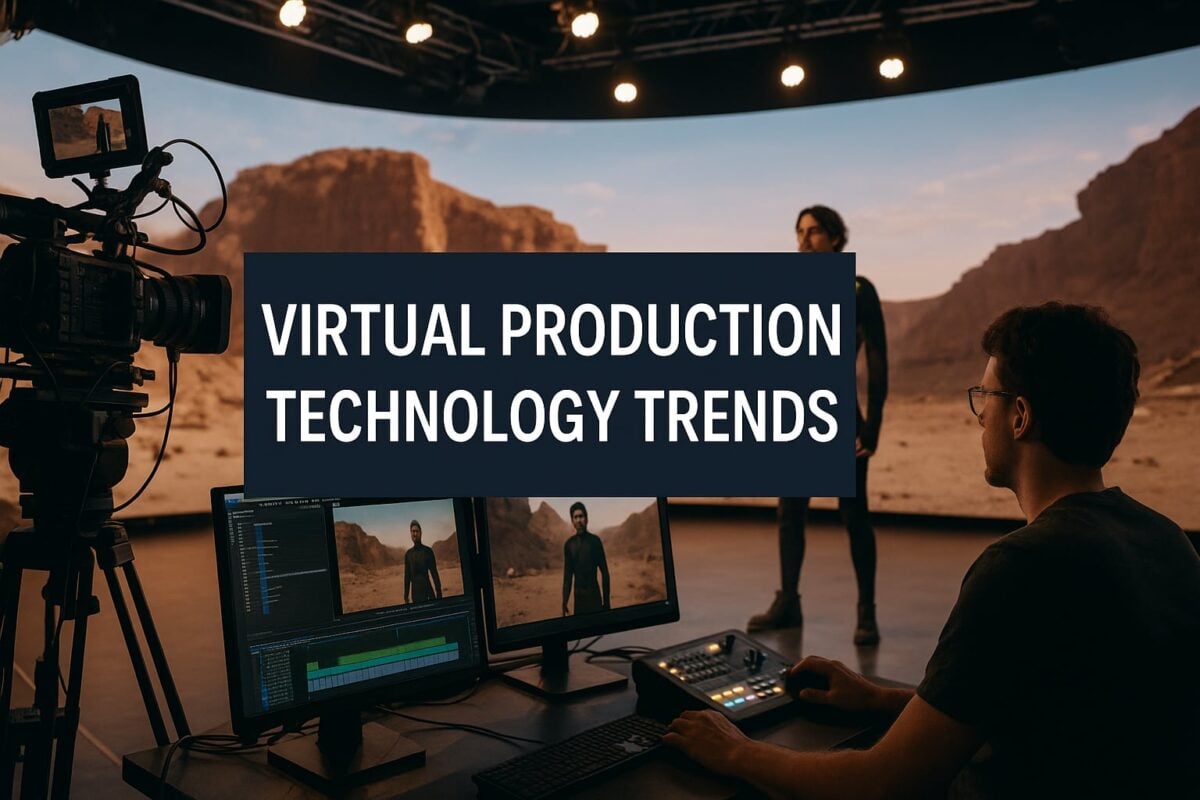
Virtual Production Technology Trends: The Future of Film and Content Creation
The entertainment industry stands at a technological crossroads where physical and digital filmmaking converge into something entirely new. Virtual production has evolved from an experimental technique used in a handful of blockbuster films to an accessible technology reshaping how content creators approach their craft. What began as LED walls displaying backgrounds has transformed into comprehensive production ecosystems that fundamentally change the relationship between planning, shooting, and post-production work.
This transformation affects everyone from independent filmmakers working with modest budgets to major studios producing tentpole releases. The technology democratizes capabilities that were once exclusive to productions with massive visual effects budgets, while simultaneously pushing the boundaries of what’s possible for those same high-end productions. Understanding these trends isn’t just about keeping pace with industry changes—it’s about recognizing how the fundamental language of visual storytelling is being rewritten.
Real-Time Rendering Capabilities
The computational power driving virtual production has reached a tipping point where real-time rendering quality rivals what previously required hours of processing time. Modern game engines like Unreal Engine and Unity have evolved far beyond their original gaming applications, becoming sophisticated filmmaking tools capable of producing photorealistic imagery at 24 frames per second or higher.
This real-time capability fundamentally changes the creative process. Directors and cinematographers can now see final-quality visual effects during principal photography rather than waiting weeks or months for post-production renders. When a director wants to adjust the time of day, change weather conditions, or modify environmental elements, these changes happen instantly on set. The creative feedback loop that once stretched across months now compresses into minutes.
The technical specifications tell part of the story: ray-traced global illumination, physically-based rendering, and advanced shader systems all contribute to imagery that holds up under the scrutiny of cinema-quality cameras. But the real revolution lies in how this technology integrates with traditional filmmaking workflows, allowing analytics and reporting systems to track performance metrics in real-time during production.
Hardware acceleration through dedicated GPU rendering and optimized rendering pipelines means that even complex scenes with multiple light sources, detailed textures, and sophisticated particle effects can maintain consistent frame rates. This reliability transforms virtual production from an interesting experiment into a dependable production methodology that crews can build entire shooting schedules around.
LED Volume Technology Advancements
LED volumes—the massive curved screens that surround actors and sets—have undergone rapid evolution in pixel density, color accuracy, and brightness capabilities. Early implementations struggled with moiré patterns, limited viewing angles, and brightness levels that couldn’t compete with traditional film lighting. Current generation LED panels solve these challenges through finer pixel pitches, improved color gamut coverage, and brightness levels that allow cinematographers to light scenes naturally.
The physical configuration of LED volumes has also evolved beyond simple curved walls. Studios now design custom geometries that wrap around sets in ways that maximize the usable shooting area while minimizing visible seams or edges. Some installations incorporate ceiling panels that provide overhead environmental lighting and reflections, creating more convincing interactive lighting on actors and props.
Color science has become increasingly sophisticated, with LED volumes now capable of reproducing color spaces that match or exceed traditional cinema cameras. This accuracy ensures that the virtual environments displayed on the walls integrate seamlessly with physical set elements under the same lighting conditions. The panels themselves have become brighter while maintaining color accuracy, giving cinematographers more flexibility in their lighting designs.
Refresh rates and synchronization technology have improved to eliminate flicker and rolling shutter artifacts that plagued early implementations. Modern LED volumes sync precisely with camera shutters across a wide range of frame rates, from standard 24fps cinema to high-speed photography at 120fps or beyond. This technical reliability means cinematographers can shoot with confidence, knowing the LED backgrounds will integrate cleanly with their footage.
Integration with Live Action Content
The real magic of virtual production happens when physical and digital elements blend so seamlessly that viewers can’t tell where reality ends and the virtual world begins. This integration represents the fundamental breakthrough that separates modern virtual production from traditional green screen techniques.
Camera tracking technology serves as the invisible conductor orchestrating this digital symphony. As cameras move through physical space, tracking systems feed precise position and orientation data to the rendering engine in real-time. The virtual environment responds instantly, adjusting perspective, parallax, and depth of field to match exactly what the camera would see if the virtual elements were physically present.
Lighting integration has reached new levels of sophistication through interactive lighting techniques. The light emitted by LED volumes doesn’t just provide a background—it actually illuminates the actors and physical set pieces, creating natural reflections, shadows, and color spill that would be impossible to achieve with green screens. This interactive lighting means that if the virtual environment shows a sunset, the warm orange light actually falls on the actors’ faces, eliminating the need for extensive color correction in post-production.
Physical set extensions allow production designers to build only the portions of sets that actors directly interact with, while virtual environments seamlessly extend these practical elements into expansive digital spaces. A small practical set piece might extend into a vast virtual warehouse, or a single practical wall might become part of an entire virtual building. This approach combines the tactile reality that actors need for authentic performances with the limitless possibilities of digital environments.
The convergence of these technologies creates what industry professionals call “final pixel” filmmaking—where what the camera captures on set is essentially the finished shot, requiring minimal post-production work. This approach not only saves time and money but also gives directors and cinematographers unprecedented creative control during principal photography, similar to how advertising management platforms provide real-time campaign control.
Artificial Intelligence in Virtual Production
Artificial intelligence has emerged as a powerful force multiplier in virtual production workflows, automating complex tasks that previously required extensive manual work. Machine learning algorithms now handle everything from camera tracking refinement to automated rotoscoping, freeing up artists to focus on creative decisions rather than technical execution.
AI-powered upscaling and enhancement technologies allow virtual environments to be rendered at lower resolutions for real-time playback, then intelligently upscaled to final quality. These neural network-based approaches analyze the content and add detail that maintains visual fidelity while reducing the computational load during shooting. The result is that production teams can work with more complex virtual environments without requiring exponentially more powerful hardware.
Procedural generation assisted by AI creates vast, detailed virtual environments with minimal manual modeling work. Instead of artists painstaking building every element of a virtual city or landscape, AI systems can generate believable variations based on parameters and examples. These systems understand architectural principles, natural growth patterns, and aesthetic consistency, producing environments that feel authentic and lived-in rather than artificially constructed.
Real-time compositing has been revolutionized by AI algorithms that can separate foreground subjects from backgrounds with unprecedented accuracy, even with challenging elements like fine hair, transparent materials, or motion blur. These systems learn from vast datasets of imagery to make intelligent decisions about edge detail and color blending that would be extremely time-consuming for human artists to achieve manually.
Predictive rendering uses machine learning to anticipate what portions of a virtual environment need the highest quality rendering based on camera position and movement. By intelligently allocating computational resources to the areas that will be most visible, these systems maximize visual quality while maintaining real-time performance. The AI essentially learns to “think” like a cinematographer, understanding what elements will be in focus and prominent versus what can be rendered at lower detail levels.
Cloud-Based Virtual Production Workflows
Cloud computing has fundamentally transformed the infrastructure requirements for virtual production, shifting from capital-intensive on-premise hardware to flexible, scalable cloud resources. This transition democratizes access to high-end virtual production capabilities while providing established studios with unprecedented flexibility in resource allocation.
Remote collaboration has become seamlessly integrated into virtual production workflows through cloud platforms. Directors, cinematographers, and visual effects supervisors can review and provide feedback on virtual environments from anywhere in the world, with changes implemented in real-time. This distributed workflow model proved essential during recent global disruptions and has now become standard practice even when geographic separation isn’t necessary, much like how brand awareness campaigns now leverage distributed digital channels.
Rendering farms in the cloud provide on-demand computational power that scales to match production needs. Rather than investing in expensive hardware that sits idle between projects, studios can spin up massive rendering resources for intensive sequences and scale back down when those resources aren’t needed. This elasticity makes high-end virtual production economically viable for a broader range of projects.
Asset libraries hosted in the cloud create centralized repositories where entire production teams can access the same virtual environments, props, and characters. Version control systems ensure everyone works with the most current assets, while permission systems maintain security and creative control. These cloud-based libraries also facilitate asset reuse across projects, building valuable intellectual property that can be leveraged for future productions.
Streaming technology allows virtual production content to be transmitted with minimal latency to LED volumes and monitoring systems. Rather than requiring local storage and processing of massive environment files, cloud streaming delivers high-quality content in real-time. This approach simplifies on-set technical requirements while maintaining the visual quality and responsiveness that virtual production demands.
Accessibility for Independent Creators
The democratization of virtual production technology has opened doors for independent filmmakers and small production companies that previously couldn’t access these capabilities. What once required multi-million dollar investments and specialized facilities can now be achieved with more modest budgets and readily available technology.
Affordable LED panels designed specifically for smaller-scale virtual production have entered the market, offering quality that rivals high-end installations at a fraction of the cost. These panels may have slightly lower specifications than their premium counterparts, but they provide sufficient quality for many production needs. Independent creators can now build small LED volumes in standard production spaces, bringing virtual production capabilities to projects that would never have justified traditional visual effects budgets.
Consumer-grade game engines provide the same core technology that powers major studio productions, available for free or at minimal cost. Unreal Engine and Unity both offer robust virtual production toolsets that independent creators can learn and deploy without significant financial investment. The learning curve remains substantial, but the barrier is now time and skill rather than access to expensive proprietary software.
Rental markets for virtual production equipment have matured, allowing independent creators to access high-end technology on a per-project basis. Studios can rent LED volumes, camera tracking systems, and rendering workstations for the duration of their shoot, paying only for what they need when they need it. This rental model makes virtual production economically viable for projects that couldn’t justify purchasing equipment outright.
Educational resources and community support have proliferated as virtual production has gained mainstream adoption. Online tutorials, forums, and user groups provide independent creators with the knowledge they need to implement these technologies effectively. This community-driven knowledge sharing accelerates the learning process and helps newcomers avoid common pitfalls, similar to how lead generation strategies benefit from shared best practices.
Environmental and Sustainability Benefits
Virtual production offers significant environmental advantages over traditional filmmaking approaches, reducing the carbon footprint of productions while maintaining or improving creative capabilities. These sustainability benefits are becoming increasingly important as the entertainment industry faces pressure to reduce its environmental impact.
Travel reduction represents one of the most significant environmental benefits of virtual production. Rather than transporting cast, crew, and equipment to distant locations, productions can recreate those environments virtually on a soundstage. This eliminates the carbon emissions associated with air travel, ground transportation, and the logistics of location shooting. A production that might have required international travel to multiple countries can now be shot entirely in a single facility.
Set construction waste decreases dramatically when physical sets are replaced with or augmented by virtual environments. Traditional productions generate enormous amounts of construction waste from sets that are built for a few days of shooting and then demolished. Virtual production allows these environments to exist digitally, eliminating the materials, labor, and waste associated with physical construction. When physical set pieces are needed, they can be minimal, focusing only on elements that actors directly interact with.
Location impact is minimized or eliminated entirely when virtual production replaces location shooting. Sensitive natural environments, historical sites, and private properties no longer need to accommodate film crews, equipment, and the inevitable disruption that production brings. Virtual recreation of these locations provides the visual authenticity productions need while leaving the actual locations undisturbed.
Energy efficiency has improved as LED technology has advanced and rendering engines have become more optimized. Modern LED volumes consume less power than the massive lighting rigs required for traditional green screen work, while providing better quality interactive lighting. Cloud-based rendering can leverage data centers that use renewable energy sources and operate at higher efficiency than on-premise rendering farms.
Future Technology Integration
The trajectory of virtual production points toward even more sophisticated integration of emerging technologies that will further transform content creation. These future developments promise to address current limitations while opening entirely new creative possibilities.
Volumetric capture technology is evolving to capture three-dimensional representations of actors and environments that can be viewed from any angle. Rather than recording flat video, volumetric systems create data-rich 3D models that can be integrated into virtual environments with complete freedom of camera movement. This technology will enable new forms of storytelling where the viewer’s perspective can change dynamically, blurring the lines between traditional filmmaking and interactive experiences.
Holographic displays represent the next evolution beyond LED volumes, promising to create truly three-dimensional visual environments without the need for screens. While still in early development, holographic technology could eventually allow actors to interact with virtual elements that appear to exist in physical space, eliminating the disconnect between flat LED displays and the three-dimensional world.
Neural rendering techniques use artificial intelligence to generate photorealistic imagery from minimal input data. These systems learn the visual characteristics of real-world materials, lighting, and physics, then apply that knowledge to create convincing virtual environments with less manual work. As neural rendering matures, it could dramatically reduce the time and expertise required to create high-quality virtual production environments.
Extended reality integration will continue to blur the boundaries between virtual production, augmented reality, and mixed reality experiences. Productions might use AR headsets during pre-visualization and planning, transition to LED volume-based virtual production for principal photography, and then extend into interactive AR experiences for audience engagement. This continuum of technologies will create new workflows that span the entire content creation and distribution pipeline, much like how streaming platforms have transformed content delivery.
Conclusion
Virtual production has matured from an experimental technique into a fundamental pillar of modern content creation. The convergence of real-time rendering, LED volume technology, artificial intelligence, and cloud computing has created production capabilities that were unimaginable just a few years ago. These technologies don’t simply replicate traditional filmmaking methods more efficiently—they enable entirely new approaches to visual storytelling that blend physical and digital elements in ways that enhance both.
The democratization of these tools means that virtual production is no longer exclusive to blockbuster films with massive budgets. Independent creators, small studios, and emerging filmmakers now have access to capabilities that allow them to compete on visual quality with much larger productions. This accessibility is fostering innovation and creativity across the entire spectrum of content creation, from experimental short films to commercial advertising to episodic television.
As these technologies continue to evolve, the distinction between “traditional” and “virtual” production will likely fade. Future filmmakers will simply have an expanded toolkit that seamlessly integrates physical and digital elements based on creative needs rather than technical limitations. The environmental benefits, cost efficiencies, and creative possibilities of virtual production suggest that these approaches will become standard practice rather than specialized techniques.
For content creators, staying informed about these trends isn’t optional—it’s essential for remaining competitive in an industry that’s being fundamentally transformed. The question is no longer whether to adopt virtual production techniques, but how to integrate them most effectively into existing workflows and creative processes. Those who embrace these changes early will be best positioned to take advantage of the opportunities they create.